Senior Software Engineer specializing in agentic AI, LLM-based systems, and rapid prototyping. I build experimental applications with Python, LangGraph, and modern AI development tools, with experience taking complex systems from prototype to production. My R&D background spans AI, computer vision, confidential computing, and applied cryptography. I'm particularly interested in creating new human-AI experiences and turning emerging AI capabilities into useful products.
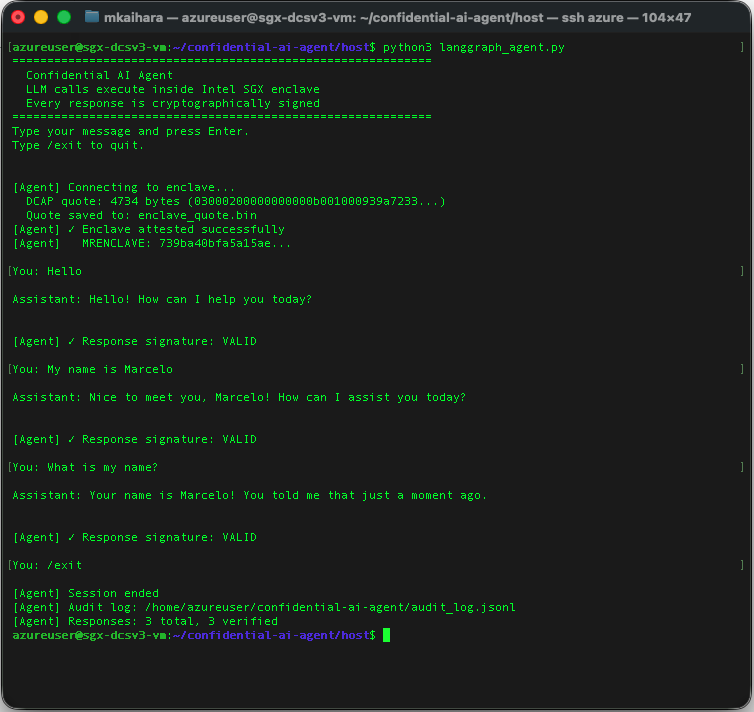
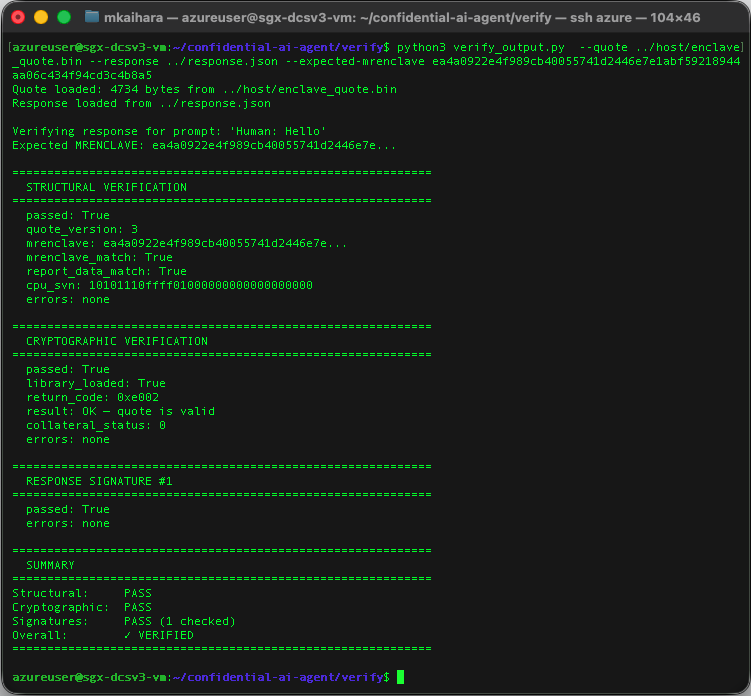
Designed and built a LangGraph-based AI agent where the Anthropic API key and ECDSA signing key live inside an Intel SGX enclave, encrypted with a hardware-derived key that binds them to this specific enclave on this specific CPU. The host process never holds secrets. Every response is cryptographically signed and independently verifiable.
What the enclave protects:
/sealed/ using _sgx_mrenclave, unreadable outside this exact enclave on this exact CPUapi.anthropic.com originates from inside SGX; the host forwards ciphertext it cannot readWhat a verifier can prove without trusting the host:
report_data in the quote contains SHA256(signing_public_key) — the signing key was present inside that specific enclaveSHA256(prompt ‖ result ‖ timestamp ‖ MRENCLAVE) is valid — the response was not tampered with in transit2026 – Present · Milan, Italy
Agentic AI & Experimental Systems
Building agentic AI systems and rapid prototypes with Python, LangGraph, and LLM APIs, with a focus on useful, observable, and trustworthy AI systems.
Engineered an attested LLM gateway using Intel SGX and Gramine, with sealed model credentials, DCAP remote attestation, enclave-signed responses, and client-side LangGraph orchestration.
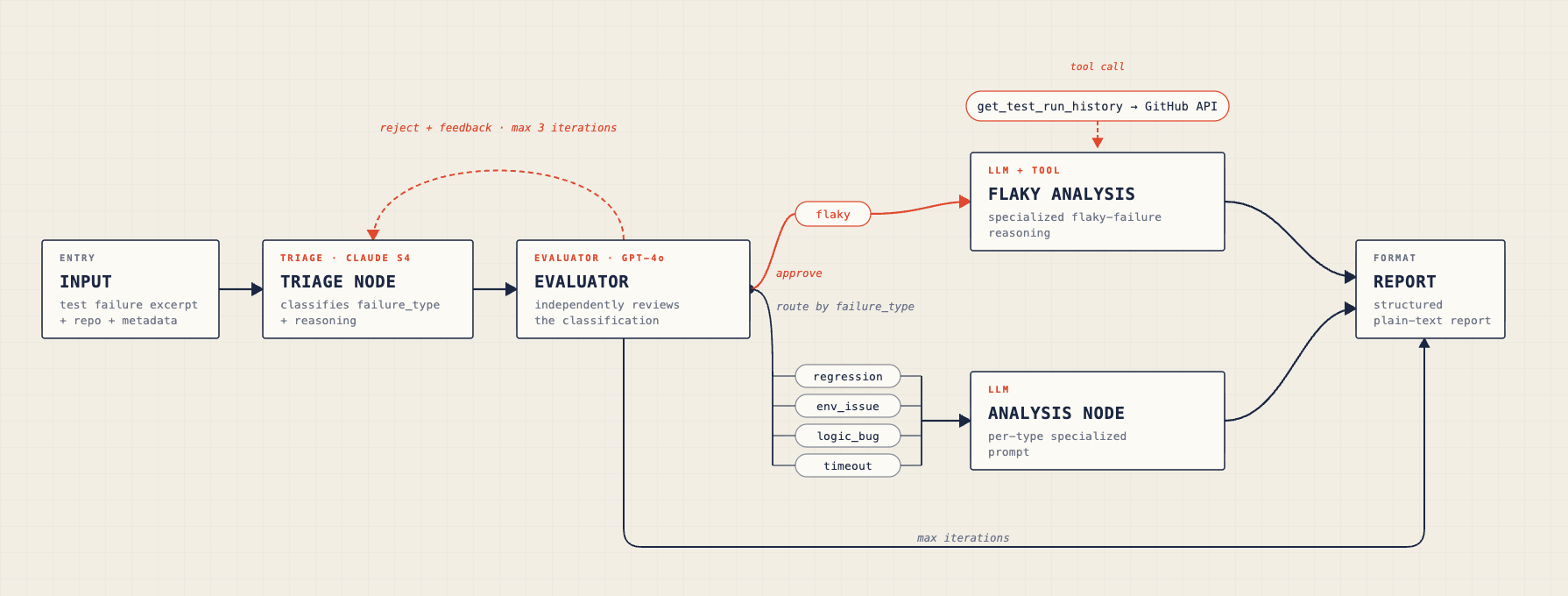
Developed a CI failure-analysis agent with cross-model reflection to explore agent-based diagnosis of software engineering failures.
2024 – 2025 · Caslano, Switzerland
Agentic AI Prototypes & Automation
Built an AI-assisted test automation prototype (OpenAI SDK, Python, Gradio, SendGrid) capable of executing satellite-processing test suites through a conversational interface and automatically generating email reports.
Delivered a web-based editor for correcting ground-truth points used in satellite rice classification, addressing a recurring data-quality problem where points were measured along roads rather than field centers and degraded downstream results. Prototyped and delivered the tool using agentic coding tools (Cline, Claude).
Cloud Migration & Geospatial Processing
Under ESA’s CRISP programme, migrated SNAP- and MAPscape-based satellite processing systems from standalone desktop applications to the CGI cloud platform using Python and Docker. Developed and containerized 14 modular processing pipelines handling multi-terabyte Earth observation datasets.
2023 – 2024 · Milan, Italy
Provided independent software engineering consulting while strengthening expertise in cloud infrastructure and containerization.
2022 – 2023 · New York, USA (Remote)
Shipped security features for Bitcoin and Ethereum cross-chain infrastructure by implementing enclave sealing and secure private-key handling, helping protect more than $2B in digital assets.
Migrated the Ethereum bridge infrastructure from the Intel SGX SDK to the Open Enclave SDK, eliminating memory corruption issues and resolving recurring daily bridge restarts.
Stabilized the integration test infrastructure by resolving Docker networking issues, reducing deployment failures by 50%.
Hardened a Shamir Secret Sharing CLI to securely handle mnemonic-based cryptographic secrets.
2021 – 2022 · Milan, Italy
Designed and developed an algorithmic trading platform using Pine Script and webhooks.
2019 – 2021 · Milan, Italy
Implemented and optimized the Poseidon hash in Rust for zk-SNARK constraint systems over the MNT4, MNT6, and BN382 elliptic curves, achieving a 246× speedup over the original implementation.
Contributed cryptographic hash primitives, large-scale Merkle tree constructions, and multi-scalar multiplication using Pippenger's algorithm to ginger-lib, Horizen's open-source Rust library for zk-SNARKs.
1st Place — Horizen Labs Private Proof of Ownership Hackathon Track (ZeroKnowledgeVoting)
2019 · Geneva, Switzerland
Integrated the TON blockchain and implemented secure wallet key management using a Hardware Security Module (HSM).
2011 – 2016 · Bern, Switzerland
Designed and implemented computer vision, image processing, and machine learning algorithms for banknote identification, authentication, and fitness classification. Developed reference models in MATLAB and production implementations in C/C++ for embedded real-time systems.
Developed a framework for retrieving account information associated with counterfeit-note deposits; the resulting systems passed European Central Bank compliance certification.
2006 – 2011 · Lausanne, Switzerland
Contributed to a record-setting computation that solved a 112-bit elliptic curve discrete logarithm problem on a cluster of 200 PlayStation 3 systems, in collaboration with Microsoft Research.
General Chair of the 11th Workshop on Cryptographic Hardware and Embedded Systems — CHES 2009 (300+ attendees).
2000 – 2006 · Nagoya, Japan
Designed massively parallel hardware algorithms for cryptography and performed RTL simulation in Verilog for ASIC implementations.
Best Paper Award — CHES 2005
Computer Arithmetic and Cryptography
Studies on Modular Arithmetic Hardware Algorithms for Public-Key Cryptography
Computer Arithmetic and Cryptography
A VLSI Algorithm for Modular Multiplication/Division
Telecommunications
Diploma cum Laude
Percentile rank: Top 1–5%
Scroll to pan · Click image to fit
Host-side session: The host process forwards requests and receives a cryptographically signed response — it never has access to the API key or the signing key.
Scroll to pan · Click image to fit
Independent verification: a third party validates the DCAP
quote (Intel root CA → genuine SGX hardware), confirms the MRENCLAVE matches
the published measurement, and verifies the ECDSA signature over
SHA256(prompt ‖ result ‖ timestamp ‖ MRENCLAVE)
— verifying that the response was signed by the attested enclave and was not modified afterward.
Scroll to pan · Click image to fit
Architecture: A test failure excerpt enters the triage node, which classifies the failure type and routes it conditionally. Flaky failures go to a specialized node that calls get_test_run_history against the GitHub Actions API to retrieve historical pass/fail rates before concluding. All other failure types go to per-type analysis nodes. The report node produces a structured plain-text output.
Scroll to pan · Click image to fit
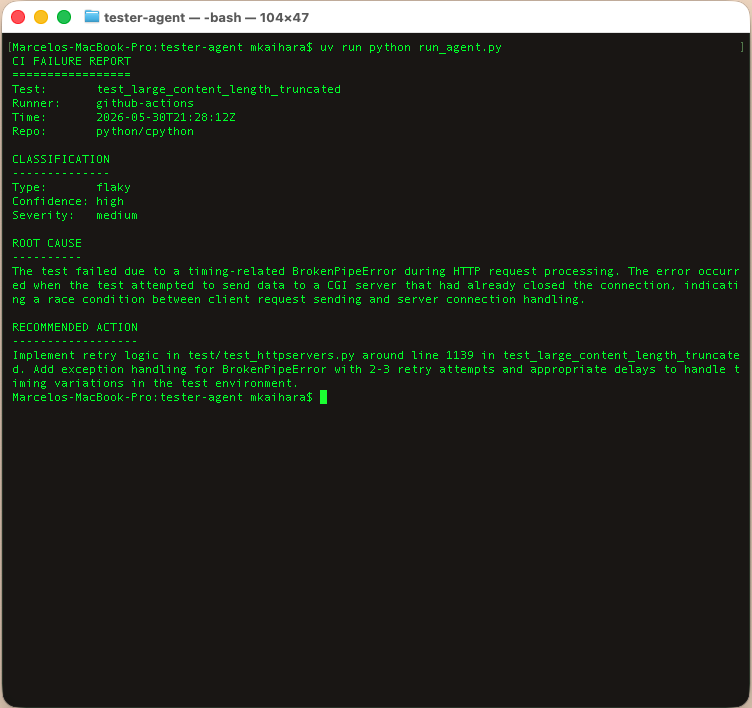
Report output: The agent classified test_large_content_length_truncated as a flaky failure with high confidence, identified a timing-related race condition (BrokenPipeError during HTTP transmission), and recommended specific retry logic with file and line reference.
Scroll to pan · Click image to fit
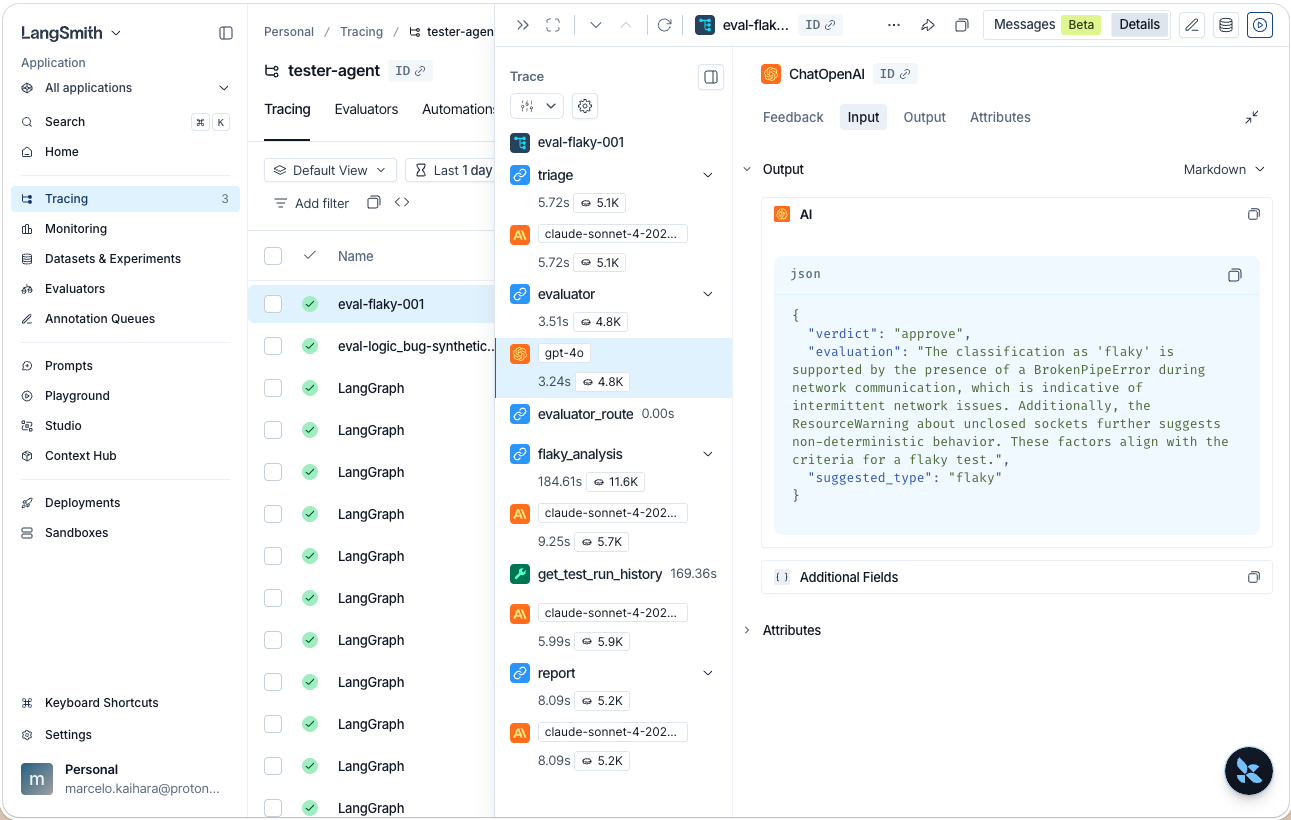
LangSmith trace: The full execution is visible — triage (3.3s), conditional routing (0s), flaky analysis (142s including a 132s get_test_run_history call downloading logs from 50 GitHub Actions runs), and report generation (7s). Total cost: $0.07.
Ask me about Marcelo's background